The Eagle’s Final Flight: The Shadow of Charles of Anjou

ENG
The Eagle’s Final Flight: The Shadow of Charles of Anjou (1266–1285)
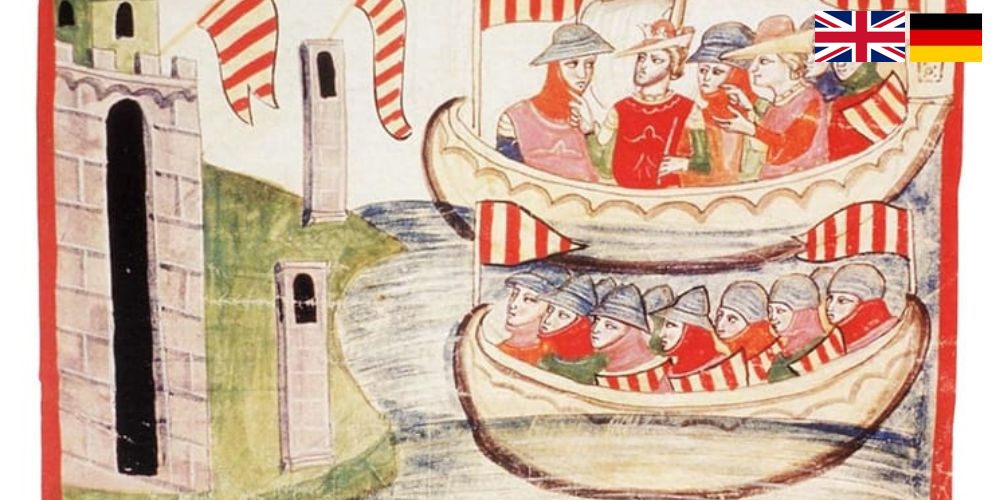
Some battles do more than redraw borders — they erase an entire vision of the world. It is 1266, at Benevento: here the armies of King Manfred, son of Frederick II, face those of Charles of Anjou, brother of the king of France, Louis IX, also known as Saint Louis, one of the central figures of medieval Christendom.
Charles is the instrument of Pope Clement IV, who had declared that he wanted to see this “brood of vipers buried alive”: a sentence with no appeal against the Hohenstaufen. At that time, the throne bowed before the altar: without the support of the Church, the power of rulers could falter under the constant threat of excommunication, a devastating instrument of political pressure that no one could afford to ignore.
And so Manfred, already isolated by ecclesiastical condemnation, sees the ground crumble beneath his feet, paving the way for the rise of Charles of Anjou: a man whose faith was as rigid as it was unshakable, and whose ruthlessness would become the new face of power in Southern Italy.
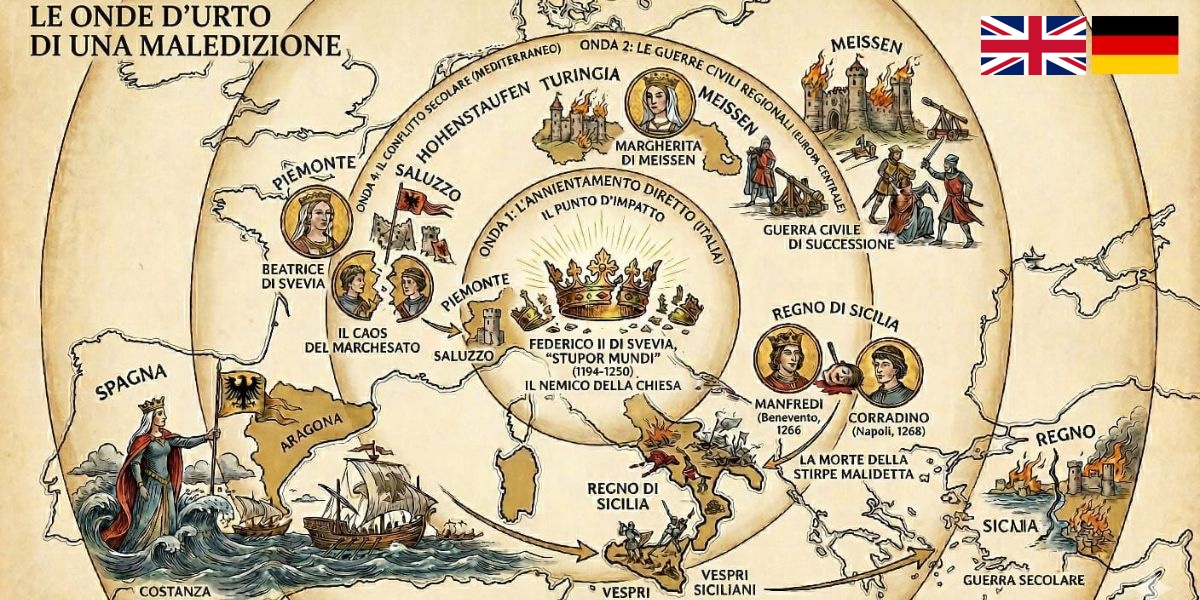
The French invader does not even grant his enemy the honour of arms. He denies Manfred even the respect due to a fallen sovereign, ordering the body of Frederick II’s son to be buried beneath a pile of stones, outside the grace of the Church, as a warning to anyone who still dared to dream of the Hohenstaufen Empire. Indeed, the exact place where King Manfred was buried was never identified.
Once in power, Charles establishes a regime of iron control and crushing taxation, draining the resources of the Kingdom of Sicily to finance his immense political ambitions and alienating a population that remained loyal to the Hohenstaufen. Driven by absolute hatred, Charles does not rest until the final glimmer of the Hohenstaufen spirit has been extinguished.
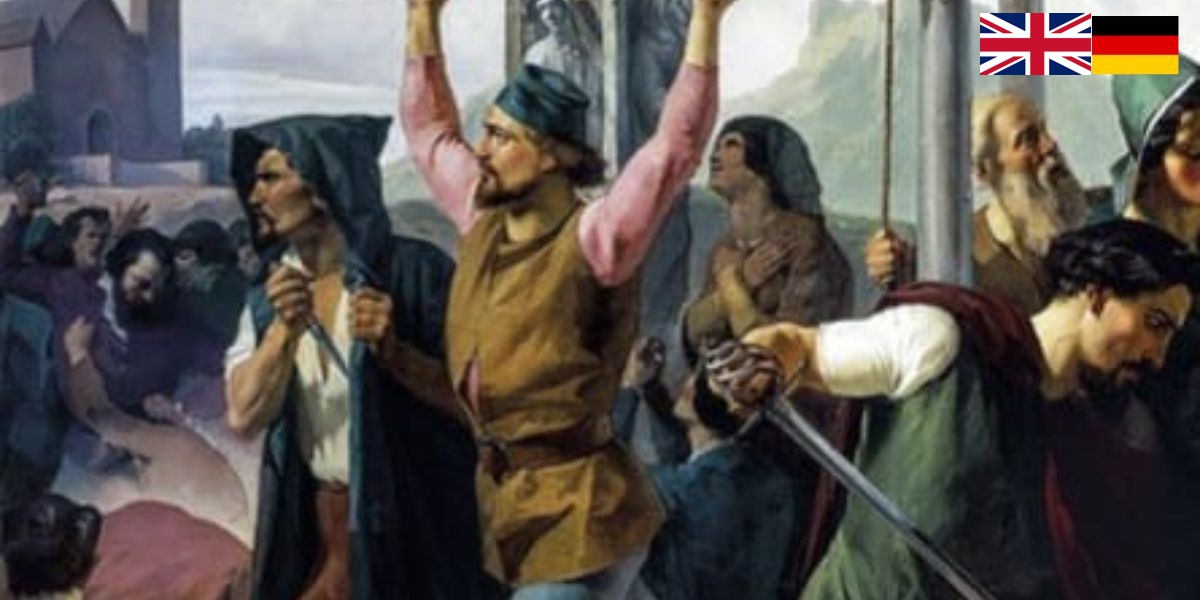
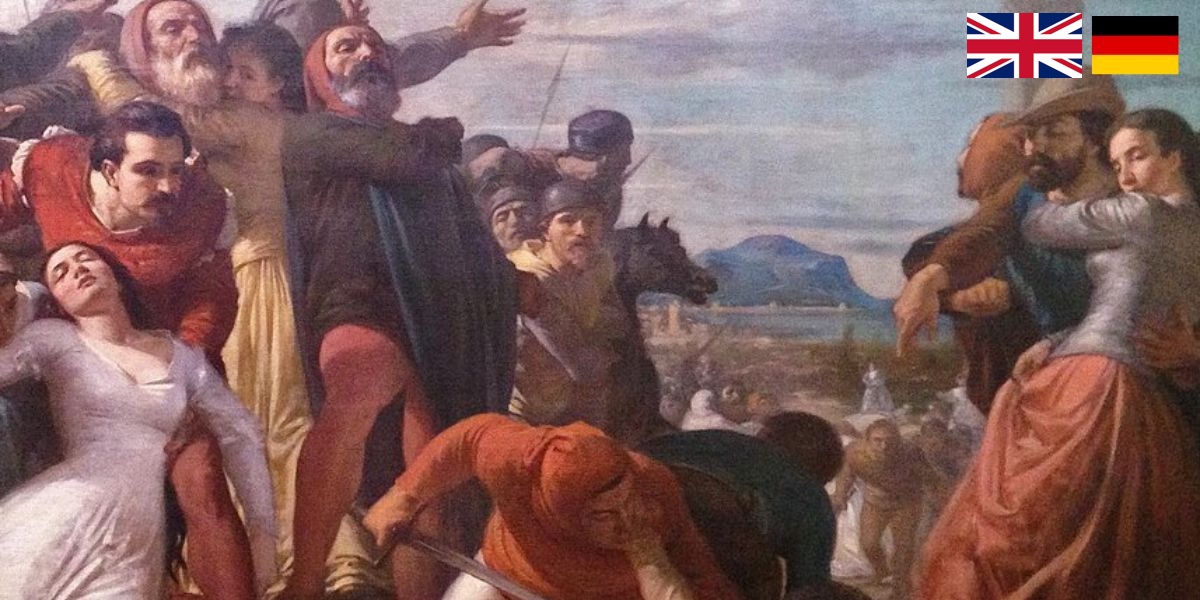
The beheading of Conradin of Swabia in Naples represents the height of Charles of Anjou’s political cruelty. Conradin, the last of the Hohenstaufen, only sixteen years old, is publicly executed after losing the Battle of Tagliacozzo in Abruzzo in 1268. It is a calculated act, intended to extinguish every remaining hope of an imperial restoration.
For almost twenty years, Charles of Anjou shaped Southern Italy in his own image: ambitious, severe, relentless. He replaced the Hohenstaufen eagle with the lilies of France, convinced that cruelty could erase the memory of a dynasty as glorious as the Hohenstaufen.
But history, as we shall see, has a memory far longer than the sword of an executioner.
DE
Das Erbe der Staufer im Schatten des Karl von Anjou (1266- 1285)
1266, Benevent: Eine Schlacht, die mehr als nur Grenzen verschiebt – sie besiegelt den Untergang einer ganzen Epoche. Hier trifft König Manfred, der Sohn Friedrichs II., auf Karl von Anjou, das unerbittliche Werkzeug eines Papstes, der die staufische „Brut von Vipern“ lebendig begraben sehen wollte.
Ohne den Segen der Kirche und unter dem Gewicht des Bannes sieht Manfred sein Reich zerfallen. Karl von Anjou übernimmt die Macht – ein Herrscher von fanatischem Glauben und beispielloser Härte: Er verweigert dem gefallenen Manfred jegliche Ehre und lässt ihn namenlos unter Steinen verscharren, fernab geweihter Erde.
Es folgt ein Regime der Unterdrückung. Karl presst das Königreich Sizilien aus, um seine politischen Ambitionen zu nähren; sein Hass ruht erst, als auch der letzte Funke des staufischen Geistes erloschen ist: 1268 lässt er den 16-jährigen Konradin, den letzten der Hohenstaufen, in Neapel öffentlich enthaupten.
Fast zwei Jahrzehnte lang dominierte das Lilienbanner des Hauses Anjou den Süden Italiens. König Karl setzte auf pure Gewalt, um das Erbe der Staufer aus den Herzen und Köpfen der Menschen zu verdrängen, doch seine Rechnung sollte nicht aufgehen.